

“I tell you, on that night there will be two in one bed; one will be taken and the other will be left.”- Jesus
Luke 17:34
Imagine being in that moment, when the Lord comes, you awaken to realize that you are being taken up, the euphoria of seeing the Lord, but in that split second you see that your husband or wife is still in bed, left behind in judgment. That is a sobering thought, a sad thought that moves me to want to be discipline to press on towards the goal and be diligent to lead her to grow in Christ.
In his book, ‘The Sacred Search,’ Gary Thomas makes a case for the why of marriage. He correctly starts with the premise that the purpose of marriage is not to make us happy, but to make us holy. The case for the why is compelling, so here I want to briefly reinforce the why and then discuss the how. For Christians, the purpose of the faith journey is to become like Jesus by Christ being formed in us (Romans 8:29; Galatians 4:19). For some, marriage will be part of that journey and it can play a significant role in our spiritual formation, at least if we enter into it with a proper understanding of why. In Sacred Search, Thomas points out that our mission should always be first in priority, not the marriage. In this, he is speaking about the priorities that we practice as single Christians need to be the priorities that we practice as married couples. From the Bible, these should be our priorities: A) God is seeking true worshipers so we need to cultivate a lifestyle of worship in truth (John 4:24; John 3:36; Luke 10:38-42); B) Set our minds and hearts on the Kingdom of God (Matthew 6:33; Luke 9:23-26; 1Corinthians 10:31; Romans 12:1-2; Colossians 3:2, 17, 23); C) be the hands and feet of Jesus in the world (Matthew 5:14-16, Matthew 28:16-20; 2Corinthians 1:3-5; Colossians 3:12-14; John 15; Romans 12); D) Endure until the end (Luke 8:12-15; John 8:31-32; 1Corinthians 9:24; Philippians 3:12-14, 18-21). These priorities as single Christians should be carried into marriage and the person you marry should have the same heart attitude towards these priorities. So as not to be misunderstood, having the same heart attitude is not the same as spiritual maturity, we do not all grow at the same pace, however to be Equally Yoked is to be like minded in regards to the things of God! If we can practice these things in our single lives, we can cultivate a spirit of contentment by which the peace of Christ, simplicity in life, the wisdom of God and the strength of His might, all which fuel faith, hope and love, is what we will bring into marriage!
 So, as you enter into marriage, you must know that there are some things that we will only learn in marriage. To be naive to this will leave you feeling disillusioned, frustrated and discouraged. Like all trials of life, we need to always be asking God for guidance to find the purpose in the pain. In this arena, you will learn a lot about yourself. For example, we may consider ourselves a giving person, a kind person, a just person, however as a single person, we largely do things on our own terms at our convenience. It’s easy to be kind and charitable on your own terms, but what happens when another sinner is now living in your personal space? The first thing that marriage will show us is how selfish we are. That will be reinforced with how petty we can be, wanting things on our terms. In marriage, we will get a glimpse of how God feels when our love is taken for granted and not appreciated. Over time, marriage will teach us how to love unconditionally, how to live sacrificially, how to die to self and through it all, we will become worshipers of God in spirit and truth (John 4:24).
In my own faith journey, I have been thinking a lot about what it means to be a true worshiper of God. In that, I have been thinking about my personal worship as well as corporate worship, and what has become clear has a lot to do with my ecclesiology, and specifically how we worship. While spending most of my faith journey in the evangelical movement, I have found a lot of joy and a lot of emotional highs. But within this, I have also been thinking about the many short comings in evangelicalism. One of the most obvious is the high divorce rate in the church. While this area of failure is statistically measurable, my observation has also noted a lot of more subtle short comings such as the lack of spiritual growth, the low priority of personal bible study, the lack of doctrinal discernment, and the large number of evangelicals who are unable or unwilling to share their faith. This is a small sample of a much longer list, but I share it because I want to draw us back to the root cause of some of these shortcomings so they are not brought into the marriage covenant. What I am about to share is important to avoid divorce, because if we are not discipline in our practice of Christianity, our worship will be weak and susceptible to allowing marriage to become an idol rather than a vehicle to grow our faith and holiness.
Last year a good friend of mine invited me to his ordination. He was being ordained as a priest in the Anglican church. (If you are unaware, the Anglican church is part of what is considered part of the “Great Tradition” within Christianity along with Eastern Orthodox, Lutheran, Roman Catholics, Episcopalians and I would also include the Church of England). My response was, “since I have overcome the Evangelical fear of all things religious, I would love to attend.” My answer surprised him, but he understood as he had left the evangelical church for reasons I am about to describe. Being a student of religion, it always bothers me when I hear people at church say, “it’s a relationship, it’s not a religion.” I think it bothers me because it is an ignorant statement. The truth is that it is both, as Christianity is actually the only system of thought in the world that has all the components of a complete religion. Examples would be doctrine, systematic theology, personal and corporate worship, statements of faith and liturgies.
In speaking of marriage as it relates to growing our faith, it is impossible to have the conversation without speaking of our liturgies. A liturgy is simply a framework by which we practice whatever it is we are seeking to perfect, grow or improve on. The goal of a liturgy is to reinforce a belief that produces habitual behavior, or becomes what we call second nature. Our first nature operates independent of thought such as breathing, pumping blood, digesting food and so on. Our second nature is cultivated by the conscious things we do until they become unconscious behaviors. Not that thinking is not involved, but rather desire is molded so that we practice the things of God as a necessity to quench a thirst for Him.
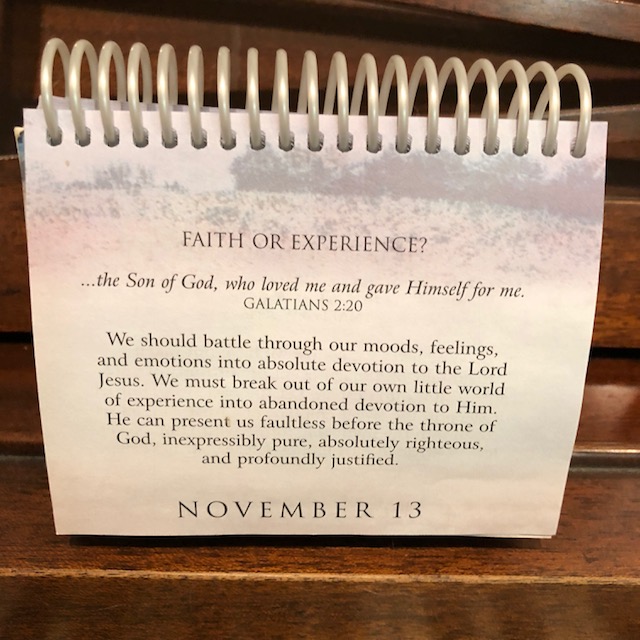
So why is this relevant? It is relevant because we all practice our cultural liturgies in everyday life, but have largely removed them from church. By way of example, when I played football, the team operated by a liturgical framework. We would get dressed, go to the field and stretch, then run laps, then sprints, then tackle drills, and so on. It was the repetition of these daily events that produced strength, improvement, cohesion within the team, cultivated a desire to achieve the common goal and revealed weaknesses. Each player had a responsibility on the field (church) that he prepared personally by watching film and in the weight room (time with God, personal Bible study, meditation, prayer). Within the Evangelical movement, though cultural liturgies still persist in the lives of the members, the church is devoid of the framework of such practices. The liturgical framework still exists and is practiced daily within the Great Tradition churches. The way this impacts believers is in the worship. Without the framework, worship is largely expressive with the focus on what I am doing for God. In the liturgy, the framework focuses on God as the subject and object of worship and I am being formed by it, thus worship is formative and not merely expressive. This may seem like a small thing, but it is a matter of paramount importance that is very subtle, but in my opinion, I believe it is the reason for the high divorce rate as well as the other shortcomings. It is impossible to surrender and die to self if our worship of God is experience based rather than formative based, because it leads us to subtly focus on ourselves rather than on God. In addition, it’s quite exhausting as we continue to look for new ways to elevate experience rather than formative worship within the liturgical framework, the sum of which is to be productivity oriented rather than cultivate inward stillness to sit at the feet of Jesus (Luke 10:39), be still before God (Psalm 46:10), find rest in Jesus (Matthew 11:28). We must be diligent to enter into that rest (Hebrews 4:11) which comes through the practice of spiritual disciplines (personal worship) and the liturgical framework such as creeds, communion, public reading of the scriptures, etc. (corporate worship).
So why is this important in marriage? This is important in marriage because marriage is a tremendous vehicle for spiritual formation, however this great blessing can be missed if our personal worship is subtly focused on myself or my spouse rather than on God. If we are focused on self and seeking complete fulfillment in the marriage, then we are not having our cups filled at the Source (John 7:37-38) to pour into our partner, so we end up depleting each other to the point of being discontent, passive aggressive behavior, perhaps infidelity and eventually divorce. Now, I do not want to over simplify it and I questioned whether or not this topic is too big for a blog post, so I decided that I did want to at least provide the main tenets of this complex conversation. I am not saying that you cannot be married and fulfill your vows until death, I know many non-believers who have done just that, however for the Christian, I am focusing on marriage as a vehicle to grow our faith and grow in personal and collective holiness. That is the goal of a God honoring marriage. Keeping vows is good, raising children is good, contributing to the social fabric as a Christian family is good, but these are all secondary to our goals set in John 4:24, Matthew 6:33 and Matthew 5:14-16.
As you seek a courting relationship, my encouragement to you would be consider who is filling their cup by God and will be able to pour into you, who will love God more than you and be able to pour out the fruit of that love on you and who will not be left behind when time expires. Part two will speak to the horizontal aspect of a God honoring marriage and the application of the above in courting.

 Visceral Reflections
Leave a reply to The God Honoring Marriage, Part 2 | Discipleship for Hearts and Minds Cancel reply